Get the latest updates from us for free

Sign-up for FREE weekly Newsletter.
Showing posts with label Gadgets. Show all posts

Review: Logitech G13 Programmable Gameboard with LCD Display

Be the first to comment!
Labels:

Review:  Logitech G13 Programmable Gameboard with LCD Display

Whether you’re rescuing hostages, on a quest with your guild, or saving humanity, you don’t want to worry about hand fatigue or hitting the wrong key. Introducing the Logitech G13 advanced gameboard--a hybrid gaming keyboard designed to complement your Logitech gaming keyboard and mouse--giving you game-changing comfort and control on a Mac computer or a PC.

Unlike other gameboards that focus only on programmability, the G13 advanced gameboard incorporates the principles of our award-winning Comfort Wave design. So whether you’re getting into World of Warcraft or walking into your next LAN party, the G13 gameboard gives you a powerful advantage over those forced to work with less. Change your game and play with the best.

Logitech G13 Programmable Gameboard with LCD Display
List Price: $79.99
Price: $59.99
From Amazon


Naturally Contoured Design
Delivering increased comfort during long sessions, the iconic contoured design complements the natural shape of your hand and fingers, while the smooth, concave home-row keys make it easy to locate buttons by touch.

Onboard Memory
A handy solution for the laptop gamer, the G13 gameboard includes onboard memory, letting you program up to five ready-to-play profiles and take them with you to your next LAN party. The G13 gameboard also offers pre-configured settings for many popular games, including World of Warcraft: Burning Crusade, Lord of the Rings Online: Shadows of Angmar, Call of Duty 4: Modern Warfare, and many others.

Customizable Backlighting
Backlit keys will help you easily locate the right key in low-light conditions or lights-out play. And you can select from hundreds of available backlight colors, so your gameboard looks just the way you want it.

25 Programmable Keys
With three game modes, 25 programmable keys, and a programmable analog stick, the G13 gameboard offers up to 87 ways for you to control your game (software installation required). And you can set up custom button-profiles for each one of your favorite titles. You can even create macros on the fly without having to pause your game.

High-Visibility GamePanel LCD
And for another tactical advantage, the 160-by-43-pixel GamePanel LCD shows live game stats, system info, and even messages from other players.

Suggested games for the Logitech G13 Advanced Gameboard:

  • Logitech Wireless Microphone
  • World of Warcraft: Wrath of the Lich King
  • Warhammer Online: Age of Reckoning
  • Age of Conan: Hyborian Adventures
  • The Lord of the Rings Online: Mines of Moria
  • Left 4 Dead
  • Call of Duty: World at War
  • Crysis Warhead
  • Fallout 3
  • Brothers in Arms: Hell's Highway
  • Command and Conquer: Red Alert 3

Top 10 Gaming Device for PC Gamers

1 Comment so far
Labels:

Top 10 Gaming Device for PC Gamers

Gaming is serious business. The game industry alone is worth US$74 billion (yes, with a b) in 2011 and the numbers are rising. Chances are, you have several games going on on your smartphone and you have one or two consoles at home equipped for some heavy gaming sessions. But if you want to talk about extreme gaming pieces – let’s just limit it to PC this time – then you will definitely love today’s showcase.


Manufacturers across the globe have been coming up with gaming devices beyond just the mice, joysticks and keyboards for years. Some are built for durability, others for added functionality and an enhanced gaming experience. Most of them are futuristic and sleek but all of them are for built for one purpose, to give the best darn gaming session hardcore gamers deserve.


Logitech Flight System G940 Force Feedback Joystick

Logitech Flight System G940 provides simulator-grade flying with authentic controls and realistic force feedback. Its design is inspired by military and commercial controls for an experience that's more realistic and more fun. Force feedback lets you feel your aircraft react to air, turbulence, and g-forces. Plus a dual throttle, rudder pedals, and interactive, programmable throttle-base buttons give you the true-to-life control you want.

Logitech Flight System G940 Force Feedback Joystick
List Price: $299.99
Price: $269.59
From Amazon


Razer Hydra PC Gaming Motion Sensing Controllers

This is the world’s first motion-sensing gaming controller for PC, according to Razer, which coupled with good connectivity provides a flawless gaming experience that’s at a whole new level. Precision magnetic motion-sensing technology and the use of ultra-low latency allows fast response that makes all the difference when every second counts.

Razer Hydra PC Gaming Motion Sensing Controllers
Price: $99.99
From Amazon


Logitech G27 Racing Wheel

Whether sliding sideways around a gravely curve, or screaming through the streets of Monaco, with the Logitech G27 Racing Wheel, the world's greatest circuits feel closer than ever. Designed to deliver the definitive sim racing experience for the PC and PLAYSTATION3, the Logitech G27 Racing Wheel features a powerful, dual-motor force feedback mechanism that smoothly and accurately simulates traction loss, weight shift, and road feel; plus a an exceptionally quiet helical gear system that virtually eliminates steering noise. And then there are the six-speed shifter with push-down reverse gear; RPM/shift indicator LEDs; 11-inch leather-wrapped rim; steel gas, brake, and clutch pedals; and 16 programmable buttons plus D-pad. All of which add up to a level of performance and realism that you might not have thought possible.
 
Logitech G27 Racing Wheel
List Price: $299.99
Price: $217.13
From Amazon


Glove mouse: Bellco Venture 3D Ion wireless Air Mouse

Be the first to comment!
Labels:

Glove mouse: Bellco Venture 3D Ion wireless Air Mouse

Unusual gadget has been created by Bellco specialists. Shown in the illustrations 3D Ion device connects to a PC wirelessly and replaces your ordinary mouse. It is worn on the hand like a glove and allows you to control the mouse pointer up to 10 m from the computer.

Bellco Venture 3D Ion wireless Air Mouse
List Price: $52.59
From: Amazon


The main advantage of 3D Ion over the traditional mouse is no need for a table or other work surface: you can move your hand in the air. Controls corresponding to the mouse buttons are located on a surface that covers index finger. There is also a button "pause", temporarily breaking the manipulator.

http://www.amazon.com/dp/B00601R236/ref=as_li_tf_til?tag=freeebookd091-20&camp=0&creative=0&linkCode=as1&creativeASIN=B00601R236&adid=0D51M1YY44XXMXNHQWCY
The set includes a mini-receiver that plugs into a USB port. According to the manufacturer "glove-mouse" 3D Ion is compatible not only with Windows but also Mac OS, Linux and Android.

Sony Walkman is Back and it Runs on Android

Be the first to comment!
Labels: ,

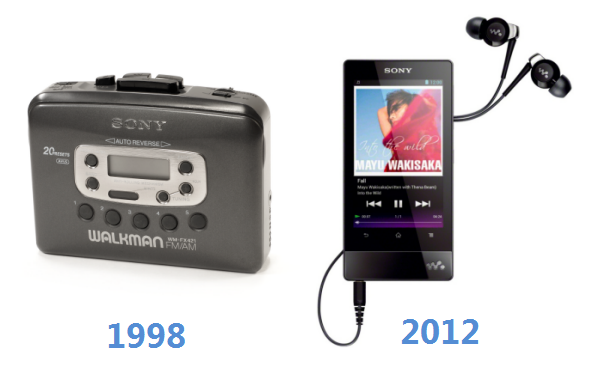
Sony is not only keeping the once revolutionary Walkman brand alive, but this summer it intends to infuse a new life to this once popular product. The Japanese electronics manufacturer has just announced a slew of new music players to compete with the likes of iPod, that carries the Walkman brand. But unlike the Walkmans of yesteryears that could play no more than 90 minutes of music the new Walkman will play 32 GB worth of music and they will be powered by Android 4.0.

sony-walkman

The top model – F800 - comes loaded with Android Ice Cream Sandwich running on a Tegra 2 (dual-core) processor, and is fully compatible with the Google Play store, which means access to all apps and even games. The screen measures 3.5 inch across which is comfortable enough for playing music, browsing, watching movies and playing games. For connectivity, it supports Bluetooth and Wi-Fi.

The F800 will be available in 8GB, 16GB and 32GB models, which is unfortunately on the lower end of the spectrum. The space constraint will be most intensely felt by those who like their music in the FLAC format. Other features include Clear Audio technologies and the integrated S-Master digital amplifier. The F800 model also comes with built in xLOUD speaker system that “cuts distortion and unpleasant clipping for clearer listening.”

The players will debut the US stores in August 2012. The 16GB model is priced at $270 and the 32GB at $300. More details at Sony’s website.

[via Cnet]

5 Ultra Portable Computers You Can Buy For Under $200

Be the first to comment!
Labels: , ,

To supplement my previous article on extremely portable computers under the price tag of $100, I decided to prepare another list for those who can afford a bit more. The ceiling price for these new breed of little computers, the size of a credit card or a thumb drive, seems to be around the $200 mark, at least for now.

Here are 5 products that you can pick up between $100 and $200.

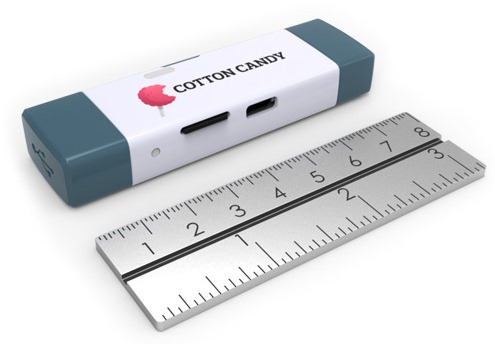
Cotton Candy ($199)

Cotton-Candy1

Cotton Candy is powered by a powerful dual-core 1.2 GHz ARM Cortex-A9 processor on an Soc (System on a chip) by Samsung, featuring a quad-core 200 MHz ARM Mali-400 MP GPU, 1GB of RAM, Audio and Video Decoder hardware engine, and TrustZone Cryptographic Engine and Security Accelerator (CESA) co-processor.

It has a USB plug on one side, which is used to power the system, and an HDMI plug on the other side, which allows it to be plugged into a display. It also has built-in WiFi and Bluetooth radios for connectivity and supporting input devices. The system can boot standalone and operate as a complete computer when plugged into a display. It's also possible to plug the Cotton Candy into a conventional computer and boot from it like you would from a regular USB mass storage device.

FXI Technologies claims it will run both Android 4.0 and the latest Ubuntu Desktop Linux operating systems.

Cotton Candy is available for pre-order at $199.

CuBox ($135)

cubox

CuBox is powered by a 800 MHz dual issue ARM PJ4 processor and 1GB of DDR3 memory with a 1080p Video Decode Engine, Gigabit Ethernet, SPDIF (optical audio), eSata 3Gbps, 2xUSB 2.0, micro-SD, micro-USB (console) and Infra-red receiver, all housed inside a cube 2 × 2 × 2 inches weighing less than 100g.

It comes with a 2GB microSD card preloaded with Ubuntu, but can also dual-boot with Android. Despite being just about 2-inch-square device size, the platform can stream and decode 1080p content, use desktop class interfaces such as KDE or GNOME under Linux, all in less than 3 Watt and less than 1 Watt in standby

You can pre-order CuBox for $135.

BeagleBoard ($149)

BeagleBoard-xM

The BeagleBoard, first introduced in 2008 by Texas Instruments, has undergone several improvements. The current BeagleBoard called the BeagleBoard-xM has a 1 GHz ARM Cortex-A8 processor capable of 720p video output, 512 MB of DDR RAM, onboard Ethernet jack, audio jacks, and 4 port USB hub. The board has plenty of display connectors - HDMI, DVID and S video output so you can plug in almost any monitor or TV into it. In addition, the board carries a camera port and a 46-pin expansion port. The BeagleBoard-xM lacks on board NAND and requires the memory and OS to be stored on to a microSD card.

The board doesn’t come preloaded with any OS but has been demonstrated to run a range of operating systems including Android, Linux, Risc OS and Windows CE. Using the expansion port, BeagleBoard can connect to a various equipment from sensors to electric motors, making it well suited to controlling electronics and robotics.

BeagleBoard-xM is priced at $149.

PandaBoard ($180)

pandaboard_es_arm_pc

The PandaBoard, another offering from Texas Instruments, features a dual-core 1 GHz ARM Cortex-A9 CPU, a 304 MHz PowerVR SGX540 GPU, a C64x DSP, and 1 GB of DDR2 SDRAM. The PandaBoard ES uses a newer SoC, with a dual-core 1.2 GHz CPU and 384 MHz GPU. Storage is via an SD Card slot allowing SDHC cards up to 32 GB to be used. The board includes wired 10/100 Ethernet as well as wireless Ethernet and Bluetooth connectivity. The board can output video signals via DVI and HDMI interfaces. It also has 3.5 mm audio connectors. It has two USB host ports and one USB On-The-Go port, supporting USB 2.0.

The computer comes prebuilt with either Android or Ubuntu. PandaBoards have been used as media centres streaming 1080p, as control units for robots, as a wearable computer, to run a gesture-control interface, and as a general-purpose Android dev tool.

PandaBoard is priced at $180 ~ $200 depending on which retailer you buy from.

Gumstix ($149)

gumstix

Gumstix offers a range of single-board systems under the brand name Overo. The main Overo boards provide the CPU and memory, and the rest are mounted with expansion cards connected via one or both on-board buses. This allows Overo to be customized according to requirements.

Gumstix motherboards come in two different configurations - Overo Earth and Verdex Pro. The Overo Earth uses a TI OMAP 3503 processor running at 600 MHz and have 256 MB of SDRAM, while the Verdex Pro motherboards use a Marvell XScale PXA270 processor running at 400 MHz or 600 MHz with up to 128 MB of SDRAM. Both boards run Linux 2.6 with the BusyBox utilities, and use the OpenEmbedded build environment to provide a full-blown Linux environment and a large range of Linux applications.

Gumstix is used in a wide range of applications – such as helping control mini-satellites and humanoid robots, as well as being clustered into a supercomputer to track botnets online. Ongoing projects are using Gumstixs to develop real-time computer-vision processing in a wearable system and an e-reader with a flexible display.

The Gumstix Overo Earth board is available for $149. Additional expansion boards such as Ethernet, imaging and GPS has to be bought separately.

Sources: 1, 2, 3, 4

3 Ultra Portable Computers You Can Buy For Under $100

Be the first to comment!
Labels: , ,

Over the last few decades, technology in general and computing in particular have developed at a tremendous pace. Computers have shrunk from room sized behemoths to something you can slip into your trouser pocket. Yes, the cell phone is a computer too and with the recent development in state-of-the-art mobile operating system such as Android and iOS, the line dividing computers and cell phones is increasingly becoming blurred.

The price is dropping fast too, but not fast enough. Several organization tried unsuccessfully to produce inexpensive notebook computers. The One Laptop per Child (OLPC) is a notable example. The goal of the project was to produce laptops that students of developing countries could afford. Initially the price was fixed at $100, but the manufacturers were unable to keep costs down and when the OLPC laptop finally went on sale in 2007, it cost twice as much.

Then in early 2011 out of the blue, a UK based organization announced a tiny computer with a tiny price tag – Raspberry Pi. This diminutive credit card sized computer is capable of anything that a desktop PC can do, including outputting HD graphics through an HDMI connection. Because Raspberry Pi doesn’t include expensive peripherals such as display, it costs just $25 or $35, depending on which model you buy.

Within a year of the Raspberry Pi announcement several more computers identical in size and performance have either been released or announced. Some of them even have a competitive price tag. Today, if you want to buy an ultra portable computer and you have just $100 in your wallet you have three choices.

Raspberry Pi ($25 – $35)

raspberry-pi

The Raspberry Pi comes in two models. Model A is slightly less capable than Model B, coming with 128MB RAM, one USB port and no Ethernet connection. It cost $25. Model B comes with 256MB RAM, two USB ports and an Ethernet connection. It will cost $35.

Both models are based on the Broadcom BCM2835 System on a Chip (SoC), which includes an ARM 11 700Mhz processor, a Broadcom VideoCore IV GPU capable of outputting at 1080p while running games like Quake 3, HDMI and VGA connectors and 3.5mm audio jack. There is no onboard storage, instead, it comes with a microSD slot. The Raspberry Pi runs on a special version of Fedora Linux.

Early this week, the Raspberry Pi foundation showed off an experimental camera module that is designed to plug into the Raspberry Pi board. The prototype version of the camera has a 14-megapixel optical sensor, but the foundation says that the final version might be less powerful in order to keep the price down. They haven’t said yet how much it will cost to purchase.

VIA APC ($49)

apc_1

The recently launched Android PC System (APC) by Taiwanese hardware manufacturer VIA includes a VIA WonderMedia ARM 11 system on a chip which is equipped with an 800MHZ processor, 512MB of DDR3 RAM, 2GB of flash storage, VGA and HDMI video outputs, speaker and microphone jacks, a microSD slot, an Ethernet port, and four USB ports. It also reportedly supports hardware-accelerated video decoding up to 720p. According to VIA, the board consumes only 4 watts when idle and 13.5 watts under maximum load.

The computer is loaded with a version of Android 2.3 optimized for keyboard and mouse input. Like Raspberry Pi, the VIA APC will ship as a bare board without a case.

At $49 a piece, the APC has more USB ports and twice as much RAM as the Raspberry Pi and also runs marginally faster.

Rikomagic MK802 ($74)

rikomagic-mk802

The MK802 has an AllWinner A10 single-core 1.5GHz ARM processor, a Mali 400 GPU, 512MB of DDR3 RAM and 4GB of onboard storage. An HDMI port on the exterior allows users to plug the computer into a high definition display. It outputs at 1080p and is said to be capable of playing high-definition video. The device also has a full-sized USB port with host support for input devices, a conventional micro-USB port, a microSD slot, and an internal 802.11 b/g WiFi antenna. The $74 computer runs Android 4.0 but the device might not be compatible with Google Android Market (Play), in which case you have to rely on third-party marketplace like the Amazon Appstore.

Among the three contenders, the MK802 is the most powerful and gets you the most bang for the bucks. The AllWinner A10 processor is almost 3 times as fast as the ARM 11 700Mhz processor used by Raspberry Pi. Also the MK802 has twice as much RAM as the Raspberry Pi.

The VIA APC is positioned at a sweet spot between the two. The processor of APC and that of Raspberry Pi is comparable in performance but the extra RAM on APC will allow more head room for programs resulting in smoother performance. However, if you are intending to build an HTPC, you should look elsewhere because APC is incapable of 1080p video output.

The Raspberry Pi wins on price but with thousands of customers in queue you have to wait for months before you can get your hands on it.

MaKey MaKey Turns Any Surface Into a Keyboard Controller

Be the first to comment!
Labels: ,

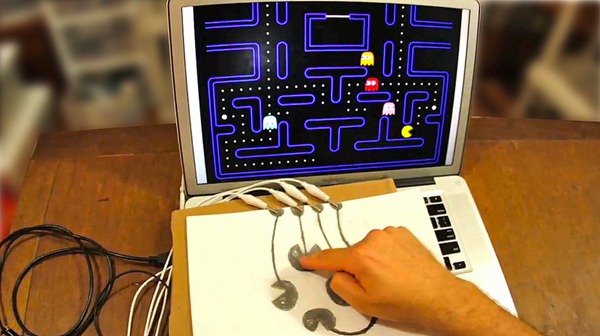
Ever wanted to play Pac Man with a pencil drawn controller or play the piano with bananas? Yes, you can, thanks to Makey Makey, a simple circuit board that turns almost any object into a touch based computer key. Currently being funded at KickStarter, it is by far one of the coolest DIY project I have ever seen.

Makey Makey plugs into a computer via USB and lets users connect the arrow keys, space bar and left mouse click to physical objects. Just connect one end of a wire to the circuit board using crocodile clips and the other end to any electrically conductive object such as bananas, pencil graphite, paint, silverware and cats. Touching the object simulates a key press which is fed to the computer via the USB port. For sensing closed switches on the input pins, high resistance switching is used so you can close a switch even through highly resistive materials like your skin, leaves, and play-doh.

makey-makey

Since no additional software is required MaKey MaKey works with all programs and webpages that accepts keyboard and mouse input.

MaKey MaKey has been used to play piano with bananas,

makey-makey2

Pac Man with a pencil drawn controller

makey-makey3

custom-made alphabet soup keyboard and many more.

If you want this, you can pledge $35 and get the kit delivered to you anywhere in the US. International destination costs an additional $10. The kit includes the MaKey MaKey, Alligator Clips, and USB Cable.

Descriptive Camera: Point, Shoot, Read

Be the first to comment!
Labels: ,

The Descriptive Camera works a lot like a regular camera — point it at subject and press the shutter button to capture the scene. However, instead of producing an image, this prototype outputs a text description of the scene. Rather than using some kind of advanced AI that can read images, it simply passes the description task to Amazon's Mechanical Turk system, which in turn distributes the job to humans. Between 3 to 6 minutes after taking the pictures - slightly longer than a Polaroid takes to develop a picture – the Descriptive Camera spits out the description in a piece of paper.

The Amazon Mechanical Turk, for those who are unfamiliar, is a crowdsourcing Internet marketplace that enables developers (known as Requesters) to submit Human Intelligence Tasks (HITs) for workers on the internet to complete, tasks that computers are unable to perform such as choosing the best among several photographs, writing product descriptions, or describing the content of an image.

Descriptive-Camera

Descriptive-Camera-output

The camera is powered by an embedded Linux platform (BeagleBone) and takes pictures using a USB webcam which is attached to a thermal printer for printing the output. A series of Python scripts define the interface and bring together all the different parts from capture, processing, error handling, and the printed output. The device connects to the internet via Ethernet and gets power from an external 5 volt source.

After the shutter button is pressed, the photo is sent to Mechanical Turk for processing and the camera waits for the results. A yellow LED indicates that the results are still "developing". With a HIT price of $1.25, results are returned typically within 6 minutes and sometimes as fast as 3 minutes. The thermal printer outputs the resulting text in the style of a polaroid print.

Checkout the creator’s blog for sample output from the Descriptive Camera.

[via Metafilter]

inPulse: A Watch that Receives Push Notifications from your Smartphone

Be the first to comment!
Labels:

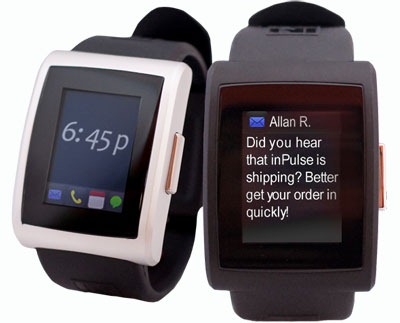
There is still hope for wristwatches. Allerta Inc. has developed a new gadget that can not only stave off the demise of this time device, but can to stop it altogether and even revert it. Their invention: inPulse, a watch that couples with a Blackberry or Android smartphone acting as a secondary display on which you can receive push notification, read emails, chat messages, check weather and more.

inPulse is powered by a 52Mhz ARM7 processor and 8Kb of RAM and carries a display of 1.3 inch across with a resolution of 96 x 128 pixels. No, you can’t play Angry Birds but you can sure read your emails. At $149, it’s costly for a wristwatch, but this is no ordinary watch.

inpulse

inPulse connects to a Blackberry or Android device running Cyanogenmod via Bluetooth and can alert you to anything you setup through the filter. These alerts are then displayed on the 1.3-inch OLED screen, and you are notified of their presence by the vibrator inside. There is no touchscreen, but a simple single button input. The watch charge via microUSB, and in 45 minutes gets enough juice to last for around four days.

Out of the box, the inPulse smartphone app lets you push emails, SMS, calendar alerts and caller ID. You can customize fonts and colors, set filtering options for emails and manage notification/vibration profiles.

The creators have also released an SDK so that developers can create more apps to run on the watch.

From NYtimes:

Some programmers are already using the new Allerta. One app offers the ability to control an iTunes music library from the watch. Another becomes an extension of a Blackberry smartphone and shows new e-mail messages and calendars on the phone through the watch’s display.

$35 Computer RasberryPi Launched. Available For Purchase

Be the first to comment!
Labels: , ,

rasberry-pi-logoRaspberry Pi, the teeny-weeny microcomputer that was announced late last year, and the one that has amassed a huge fan following even before it was released, is finally available for orders.

The Raspberry Pi is available at either Premier Farnell or RS Components. Search for Raspberry Pi, and then follow the normal shopping and checkout process. Apparently, the announcement has caused a huge rush of buyers and both the retailer's websites are down at the time of this writing.

Update: Both sites have sold out within minutes.

Those who have tuned in late, the Raspberry Pi is a small computer, no bigger than a credit card, running on 700MHz ARM11 processor with 256MB of RAM and with all essential connectivity options such as VGA ports, HDMI, USB, Wi-Fi and Ethernet ports.

The tech world is pretty excited about Raspberry Pi. For $25 or $35 you can get a fully functional ARM-based computer running a special version of Fedora Linux; all you need to do is plugin a monitor, keyboard and mouse. The HDMI output supports 1080p playback, and we have already seen videos of games being played on it. Raspberry Pi will be an impressive media center.

rasberry-pi

The whole things is also pretty damn small. Although you can’t use it without a monitor and keyboard/mouse hooked up, it’s still nice that you can carry it around and hook it up at home, at work, or in conference rooms.

All of the first units that are on sale are the $35 Raspberry Pi Model B. These are the more fully featured versions of the Raspberry Pi that include an Ethernet port, and 2 USB ports. The $25 Model A has been reworked to include 256MB of RAM – double than what were originally planned to offer – and will be going into production immediately.

This first launch is aimed at software and hardware enthusiasts, makers, teachers and others who want to build exciting things with the Raspberry Pi before the official educational launch, which will happen later in 2012.

The developers expects that when Raspberry Pi is launched into the educational market, there will be an experienced community of people using and making things with the Raspberry Pi. Software will be more mature and free of obvious bugs, and easier for children and educators to use.

BSNL to Launch Pantel-Made Android Tablet to Rival Aakash

Be the first to comment!
Labels: ,

BSNL, the state-owned telecom giant, announced on Friday that it would bring three Android tablets in partnership with Pantel, a company based in Noida. Of the three, the cheapest one TPAD IS701R is priced at just Rs. 3,250 -  a few hundred rupees more than the commercial version of Aakash tablet with better configuration.

penta-tablet

The Penta TPAD IS701R features a 7 inches resistive touchscreen, powered by a 1 GHz processor, 256 MB RAM and 2GB of Flash memory that can be increased up to 32 GB via memory card. The tablet has Wi-Fi connectivity, 3G dongle support, accelerometer, HDMI port and a camera on the front. The tablet will be sold along with special data plans and 3G services from BSNL. The low cost tablet will appeal to Aakash fans who are still waiting for their devices. Penta, on the other hand, expects to start shipping by the first week of next month. It remains to be seen whether they can keep up with the dates.

Penta will also launch two other models priced slightly higher at Rs 10,999 and Rs 13,500.

The Penta TPAD WS704C features 7 inches capacitive touchscreen along with 1 GHz processor, 512 MB RAM, and 4GB internal memory expandable up to 32 GB. Along with Wi-Fi and 3G dongle support, this tablet will also carry a SIM card slot, GPS, Accelerometer, Bluetooth and two cameras one each at the front and rear. This tablet is priced at Rs 10,999

The third tablet, Penta TPAD WS802C has an 7 inches capacitive touchscreen with 1.2 GHz processor, 512 MB RAM, and 4GB internal memory expandable up to 32 GB, other features being same as TPAD WS704C. This tablet is priced at Rs 13,500.

You can pre-book your tablets on this page.

[via Times of India]


Recent comments

Recent comments

Followers

Sponsors

Recent comments

fefew

Recommend on Google

Copyright © 2011 All Rights Reserved Thesis skin. by Nitin. Converted into Blogger Template by TheTechFizz.