Get the latest updates from us for free

Sign-up for FREE weekly Newsletter.
Showing posts with label Science. Show all posts

Watch The Transit of Venus 2012 Online

Be the first to comment!
Labels:

One of the rarest celestial events of the century will occur tomorrow and will be viewable from select regions of the Earth. The planet Venus will trek across the disc of the sun, an event known famously as the Transit of Venus.

Transits of Venus are among the rarest of predictable astronomical phenomena. They occur in a pattern that repeats every 243 years, with pairs of transits eight years apart separated by long gaps of 121.5 years and 105.5 years. The next transit of Venus will occur on 5 and 6 June 2012, and will be the last Venus transit this century. The prior transit took place on 8 June 2004. Altogether only six such transits have been observed and recorded in human history. It is a real privilege to be alive during such an important period of time.

Visibility_of_2012_Transit_of_Venus.jpg

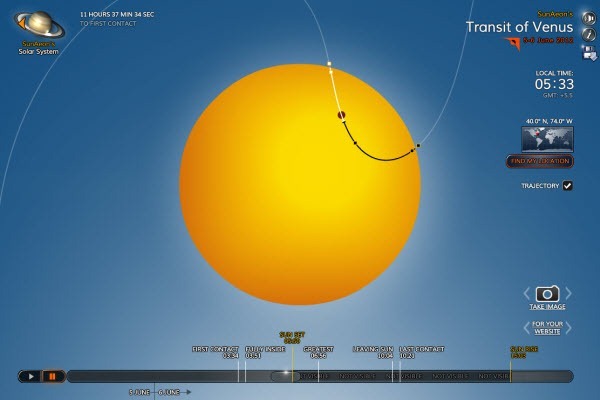
The transit will begin at 22:09 UTC on 5 June 2012, and will finish at 04:49 UTC on 6 June, during which the planet will appear as a small, dark disk moving across the face of the Sun. Admittedly, it will be as interesting as watching grass grow, yet the excitement among space buffs is palpable.

You can catch a live webcast of the transit on NASA’s website. Another way to view this event on your mobile phone is through the app VenusTransit, which is available on Android and iOS.

The phone app will allow citizens around the world to witness this rare phenomenon and to contribute their observation to a collective experiment to measure the sun’s distance. The phone app will assist the user in timing the transit and will also tell you the precise time when the transit will start based on your GPS location. After the transit, you can access your data on a map on our website.

You can lookup the timing of the various stages of the event for major cities on this page. If you can’t find your place, just punch your location into this converter to get the timing of the event in your local time.

A beautiful Flash animation of the transit is also available here.
venus-transit

Venus transits are historically of great scientific importance as they were used to gain the first realistic estimates of the size of the Solar System. Observations of the 1639 transit, combined with the principle of parallax, provided an estimate of the distance between the Sun and the Earth that was more accurate than any other up to that time. In addition, the June 2012 transit will provide scientists with a number of other research opportunities, particularly in the refinement of techniques to be used in the search for exoplanets.

How the Night Sky Will Look Like 7 Billion Years From Now?

Be the first to comment!
Labels: ,

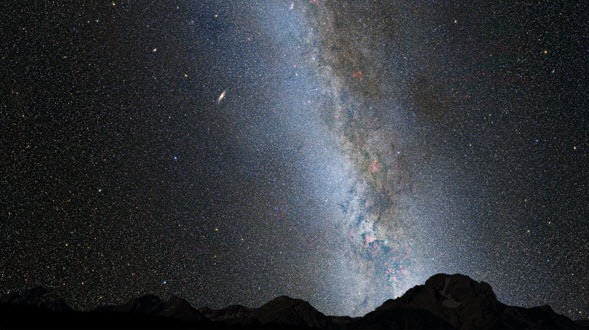
NASA astronomers using the Hubble Space Telescope have worked out when precisely our Milky Way Galaxy will crash into its neighbour, Andromeda making it possible to portray, with a fair degree of accuracy, how the night sky above our head will appear 7 billion years from now. While it’s another thing, there will be no humans on Earth to witness the spectacle.

The Andromeda galaxy located some 2.6 million light-years from Earth is on a collision course with the Milky Way. The pair are being pulled together by their mutual gravity and the scientists expect them to begin to merge in about four billion years' time. A further two billion years on and they will have completely merged to appear as a single entity.

Although the galaxies will plow into each other, stars inside each galaxy are so far apart that they will not collide with other stars during the encounter. However, the stars will be thrown into different orbits around the new galactic center. Simulations show that our solar system will probably be tossed much farther from the galactic core than it is today, but our Earth and solar system are in no danger of being destroyed.

today

The night sky as it is today.

andromeda-milkyway-collison375

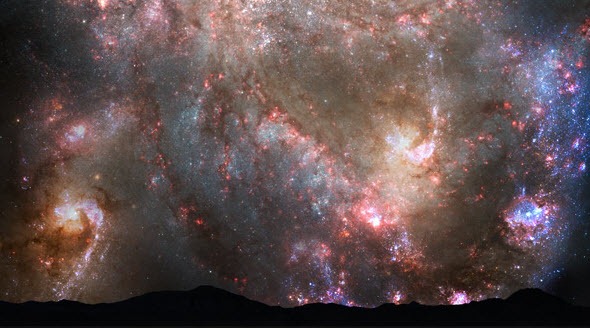
In 3.75 billion years Andromeda fills the field of view.

andromeda-milkyway-collison385

In 3.85 billion years the sky is ablaze with new star formation.

andromeda-milkyway-collison395

In 3.9 billion years, star formation continues.

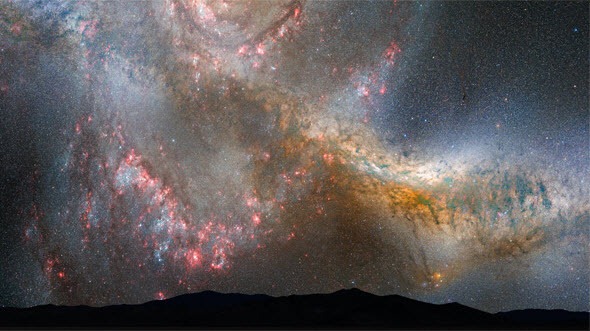
andromeda-milkyway-collison4

In 4 billion years Andromeda is tidally stretched and the Milky Way becomes warped.

andromeda-milkyway-collison51

In 5.1 billion years the cores of the Milky Way and Andromeda appear as a pair of bright lobes.

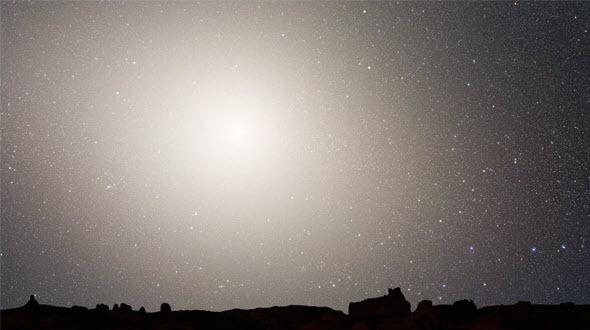
andromeda-milkyway-collison7

In 7 billion years the merged galaxies form a huge elliptical galaxy, its bright core dominating the nighttime sky.

"After nearly a century of speculation about the future destiny of Andromeda and our Milky Way, we at last have a clear picture of how events will unfold over the coming billions of years," said Sangmo Tony Sohn of STScI.

For the very first time, we've been able to measure the sideways motion - in astronomy, also known as proper motion - of the Andromeda Galaxy ”

Previously, it was unknown whether the far-future encounter will be a miss, glancing blow, or head-on smashup. This depends on M31’s tangential motion. Until now, astronomers had not been able to measure M31's sideways motion in the sky, despite attempts dating back more than a century. The Hubble Space Telescope team, led by van der Marel, conducted extraordinarily precise observations of the sideways motion of M31 that remove any doubt that it is destined to collide and merge with the Milky Way.

The animation above depicts the collision between our Milky Way galaxy and the Andromeda galaxy. Hubble Space Telescope observations indicate that the two galaxies, pulled together by their mutual gravity, will crash together about 4 billion years from now. Around 6 billion years from now, the two galaxies will merge to form a single galaxy. The video also shows the Triangulum galaxy, which will join in the collision and perhaps later merge with the Andromeda/Milky Way pair.

[via Nasa]

World’s Longest Running Lab Experiment: 85 Years On and Viewable on Webcam

Be the first to comment!
Labels: ,

The pitch drop experiment began in 1927 when Professor Thomas Parnell of the University of Queensland in Brisbane, Australia, set out to demonstrate to his students that some substances that appear to be solid are in fact very high viscous fluids. He used tar pitch, a derivative of coal once used to waterproof boats, in an experiment to prove his point. At room temperature, pitch appears to be solid and can even shatter if hit with a hammer, but despite its look and feel, pitch can also flow at room temperature, albeit extremely slowly.

For his experiment, Parnell melted some pitch into a glass funnel with a sealed stem and allowed it to cool for three years. In 1930 he cut the sealed stem, hung the funnel over a beaker, and waited. It took eight year before the first drop fell into the beaker and another nine years before the second drop hit. Parnell didn’t live to see the third drop fall in 1954, as he passed away in September 1948. By then, the experiment was stored away in a cupboard of the physics department.

Pitch_drop_experiment_with_John_Mainstone

The Pitch Drop Experiment with its current custodian, John Mainstone in a picture taken in 1990.

The pitch-drop experiment might have fallen into obscurity had it not been for John Mainstone, who joined the University of Queensland physics department in 1961. One day a colleague said, “I’ve got something weird in this cupboard here” and presented Mainstone with the funnel, beaker and pitch, all housed under a bell jar. Mainstone asked the department head to display it for the school’s science and engineering students, but he was told that nobody wanted to see it. Finally, around 1975, Mainstone persuaded the department to publicly display the experiment in a cabinet in the foyer of the department building.

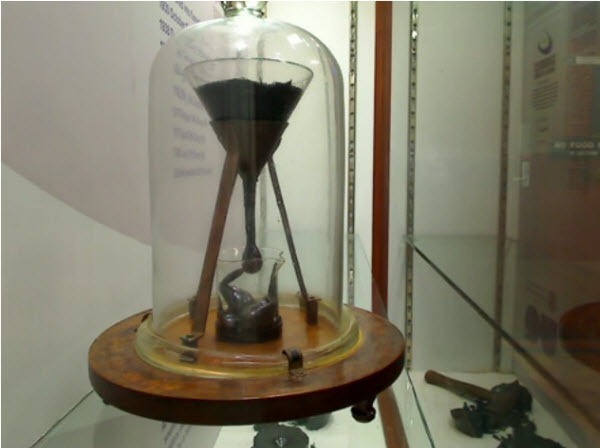
Today the experiment is broadcast on a live webcam. The eighth and most recent drop fell on November 28, 2000, but it couldn’t be recorded as the camera malfunctioned when it fell. To this day, no one has actually witnessed the pitch drop fall, but you could try your luck.

Pitch_drop_experiment_webcam

The Pitch Drop Experiment on webcam

The experiment was not originally carried out under any special controlled atmospheric conditions, meaning that the viscosity could vary throughout the year with fluctuations in temperature. However, sometime after the seventh drop fell in 1988, air conditioning was added to the location where the experiment resided. The temperature stability has lengthened the interval between each drop.

Mainstone says it’s impossible to predict when future drops will occur, especially because the lapses between will grow longer as gases in the pitch escape and the weight of the pitch in the funnel decreases. He expects, however, that the ninth drop won’t break off before 2013. The experiment is far from complete. Mainstone says that it has at least 100 years left if someone doesn’t throw it out.

In October 2005, John Mainstone and the late Thomas Parnell were awarded the Ig Nobel Prize in Physics, an America parody of the Nobel Prize, for the pitch drop experiment.

The experiment is also recorded in the Guinness Book of Records as the world's longest continuously running laboratory experiment.

[via Cnet and Popsci]

Related Reading: World’s First Webcam Kept Watch on a Coffee Pot


Recent comments

Recent comments

Followers

Sponsors

Recent comments

fefew

Recommend on Google

Copyright © 2011 All Rights Reserved Thesis skin. by Nitin. Converted into Blogger Template by TheTechFizz.